Life is really speeding up for me: the Skaņu Mežs festival is just around the corner (this weekend and the next), the Riga cycling marathon is on June 7. And then there's news: we barely had time to get back from Turkey, and Shchukin is already inviting us to Norway for Līgo, and I have to decide right away. Norway is probably the only country I'd go to a second time, it's so beautiful there. But going to Norway now means missing out on the Sonar music festival, and Roskilde (or whatever else) – because Norway is expensive in itself, and you still have to get there.

Anyway, let's get back to our Turkish sheep for now, who, as you may remember, got stuck after getting off the ferry in the dark, and without any lighting equipment, plus there was a crazy steep hill looming on the right. A few people had brought flashlights with them, but they were tent headlamps. When riding a bike, they're only good enough for cars to notice you – you can't see the road at all. I have a Q5 LED flashlight, it shines great for such a tiny gizmo, and now there's an even better one – the P7.

Igor Shchukin, however, thinks that even the strongest flashlight is still not enough, so it's better to get used to the dark – that's how he likes it. It seems not many people share this point of view – they let me go up front to light the road. Igor (the navigator), on the contrary, really liked my flashlight. In general, I'm fine riding in the dark – the headlights are good, and my jacket and cycling jersey glow like a road worker's (more on those later).
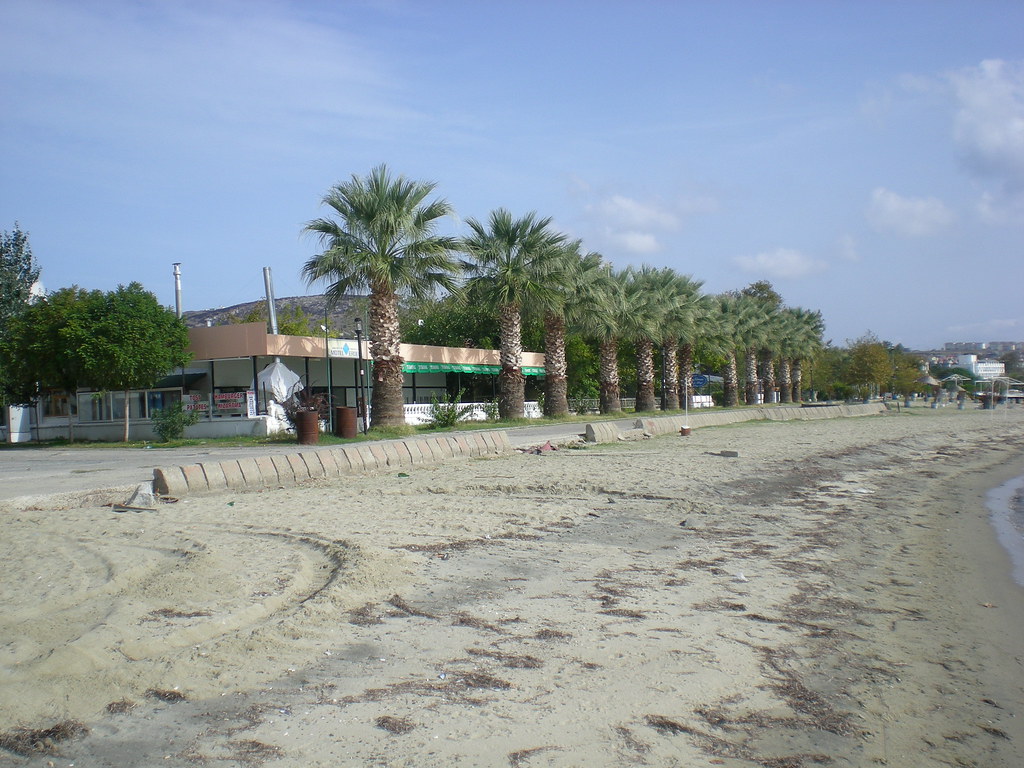
In general, according to the plan, we were supposed to reach Erdek, a local attraction, on this day, or at least the next morning. It was one of only three places on our route that were mentioned in the guidebooks as beautiful and interesting for tourists. But while we were looking for a campsite in the dark, we wasted all our time, and one attraction passed us by, which somewhat saddened me, as a culturologist.
Since you can't snap photos at night on my little IXUS 40 point-and-shoot, I will show you views of the Erdek that never was from Flickr. As for our adventures, we were riding through the hills at night, and when we saw people, we tried to find out from them where the campsite was, which was supposedly marked on our maps.

I communicated long and hard with one slightly tipsy guy because the plot looked like a campsite. True, it said Pansiyon (pension) – what that is, we'll find out in a few days. As for this place, the Turk threw up his hands and kept repeating that he'd be happy to put us up inside the cabins, but all the spots were taken, and we couldn't pitch a tent. Supposedly because he's not the real owner and doesn't have the authority to do so. But that's more me muddying the waters, as usual, than telling the truth.

As you can imagine, I couldn't master Turkish to such a degree in a few evenings with phrasebooks; I guessed more from the context, gestures, and regretful facial expressions. But the Turks reacted quite positively to my exclamations of “Merhaba!” (hello) and “İyi geceler!” (good night). And in general, on our way, they tried to help us in every possible way, and some even communicated with us entirely unilaterally – without the slightest understanding on my part of what they were going on about. I had to answer everyone “Anlamadım” (I don't understand) or İyiyim (I'm good).

Since I've started talking about linguistics, I'll say that we almost never encountered “Allahaısmarladık”, meaning “May Allah bless you”, although in theory, strict religious fanatics, which narrow-minded people imagine Turks to be, should only say that when saying goodbye. In reality, they usually used “Güle güle”, which translates to “Go with a smile”, but simply means “Bye”.
Now is the time to report that Turkey is very heavily plowed and sown – there are practically no empty plots in the places we visited. For tourist-nerds like us, meaning those who ride leisurely with luggage, this isn't very good: if there's no campsite, there's nowhere to pitch a tent. We never did find a campsite. In Morocco, our brethren slept right on the ground under olive trees, but there is an infinity of space there. In Turkey, however, there are houses and people all around – who knows how they'll react to seeing a space-age mountain tent in their garden in the morning. In some despair, we even started looking for a motel or even a hotel. We only found some closed, Roman-style majestic building among peasant hovels, as a result of which we turned back – since the next day we would have had to return anyway to continue our journey. The building was most likely closed because spring is not tourist season in Turkey – which has both pros in the form of a lack of tourists and low prices, and cons, one of which we encountered.

As a result of all these maneuvers, we had to act spartan-style. Namely, pitch the tent wherever we had to. We found some half-abandoned orchard with ruins and, for some reason, a bottle hanging on a tree. We stuck the barely pitched tents between bumps and thorns. This would have been the time to hit the sack, but the restless and Chelyabinsk-level tough Maris decided to strictly adhere to his duties and started cooking dinner. And this was at 1 AM!
Observant folks will say: “Hey, wait a minute, how come? You didn't buy fuel for the stove, did you?”
That's right, we thought we wouldn't buy it either. Even though we came across gas stations on our way, upset by the Turk on the ferry, I somehow didn't even want to ask. Especially since I don't see the difficulty in skipping a meal sometimes, thank goodness the energy reserve in my torso is solid enough as it is. But my comrades-in-arms don't share such negligence towards their bodies – supposedly, to engage in physical activity, you need energy and a good five-meals-a-day diet. Igor (the navigator) was particularly insistent on this, though not this time, but later on.

Fortunately, that's what a team is for – to force others to act. Sergey (the doctor) was full of energy and strength, as well as some knowledge of English, as a result of which we headed to the gas station. And lo and behold – without any talk, they sold us a 1.5-liter bottle full to the brim with delightfully smelling, fresh, high-octane 98E. For a stove, the better the gas, the more reliable – high-octane isn't needed at all, but the probability that it's cleaner is actually higher. You could probably buy branded premium too, but it seems they didn't have them at that station, or I was too tired to translate.

In any case, thanks to Maris (the quartermaster), we successfully dined on pasta with stewed meat, and even drank some tea. We bought bottled water and brought it along beforehand, that's how it's usually done.
By the way, there was a question in the last part: who is that riding without a helmet? That's Igor (the navigator) – he's also without medical insurance, quite the extreme guy. In his defense, I can only say that right now, as we know, there's a crisis.
To defeat it and financially help culture, I'm leaving for Skaņu Mežs for the weekend, and the next part will only be on Tuesday. But it will be about the first assault on the mountains and the pseudo-Latgalian nature.